
No plan, no structure
You run a lot one week, barely at all the next. Consistency never sticks.
Personal coach on Telegram
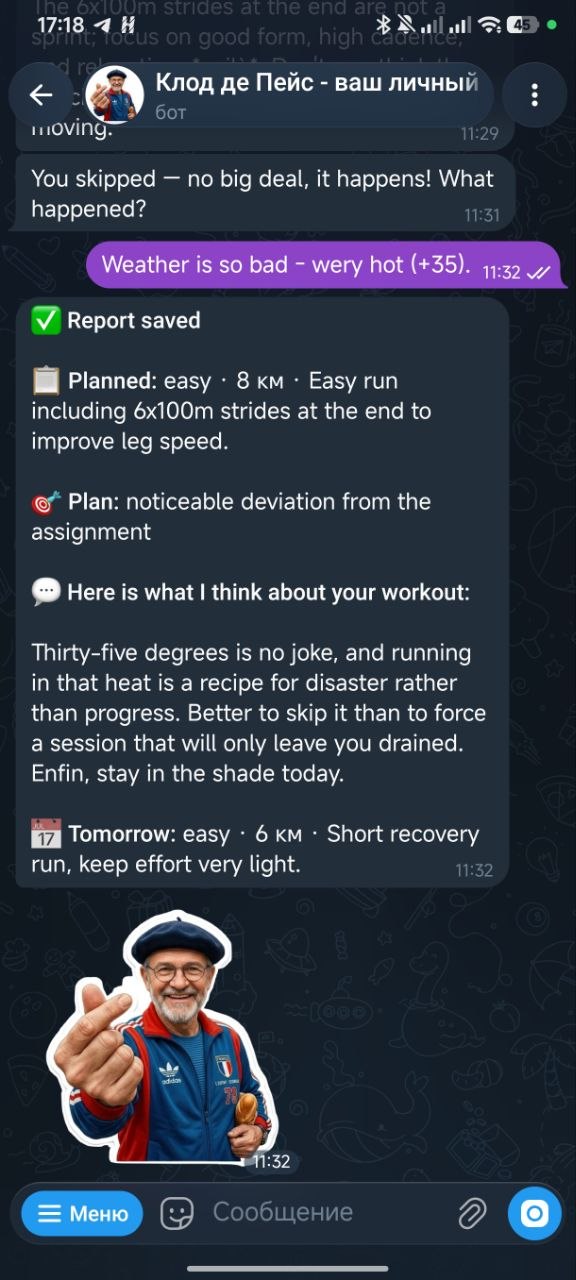
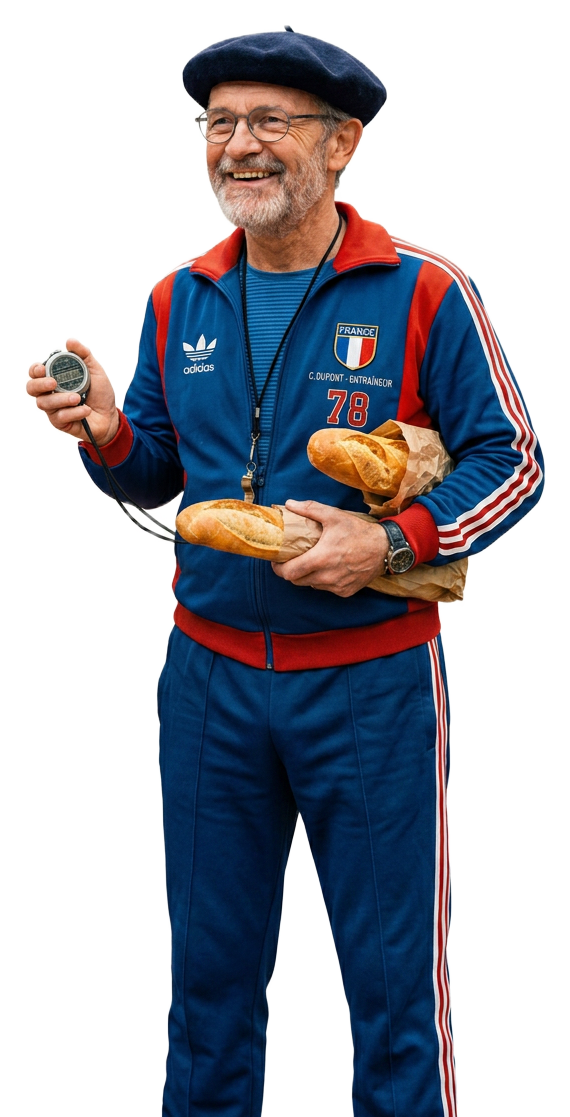
I'm Claude de Pace — your running coach. I'll build a plan around your goal, check how you're sticking to it, and adjust when needed. A short report is enough to start. Zones and a race prediction come from your history.
No separate app · from 490 ₽/mo
 Allez, on y va!
Le problème
Most plans give you a schedule — but don't help you keep the rhythm, understand your load, or adapt to real life.
You run a lot one week, barely at all the next. Consistency never sticks.
How much to add, when to pull back — without context, it's guesswork.
Trackers and spreadsheets need their own discipline. After 2–3 weeks, it all gets dropped.
Templates from the internet ignore your fitness, schedule, and how you actually run right now.
To begin, distance, time and how the run felt are enough. Claude will build zones, threshold and a race prediction himself — once there is a training history.
From your first message to your first week of training — in seconds, not settings.
 01
01Your goal, experience, and limits — briefly, in a familiar Telegram chat. If you don't run yet — nine weeks of walk-run up to 30 minutes. You can set more than one race, including a custom distance.
 02
02Clear workouts, rhythm, and reminders — no spreadsheets.
 03
03After a run — a load score and a short report. Then /today lets you compare plan vs reality, fix the numbers, or cancel the report.
 04
04A skip, fatigue or illness — the plan recalculates. You can also move a single day: “move the tempo to Saturday” — with a preview and a confirm.
Plan → run → quick report → precise adjustment.
Beyond the tracker
Watches count your heart rate. Claude says what it means for you — and what to do with the plan.
A tracker says “avg HR 158”. Claude says what that means for you.
You don't need VO₂max to start. Ordinary reports are enough: distance, time, heart rate, how hard it felt. Once there is history, Claude builds a 4-week picture of your form: heart-rate and pace zones, a threshold estimate, a VO₂max estimate, and predictions for 5K, 10K, half, marathon and your own goal. Those zones then feed the plan: “easy” means your easy, not a generic chart. In the bot: profile → Form.
From your reports over 4 weeks, using Daniels' VDOT model. Quality sessions with a written report are needed — at least one tempo and one interval. This is not a lab test and not a substitute for a doctor.
After a run — a load score and a short note. Then /today shows plan vs what actually happened. Wrong numbers or the wrong session — edit or cancel the report. The plan takes that into account.
If you don't run yet — this is not “marathon in 16 weeks”. Nine weeks of walk-run: walking and short easy jogs, three times a week. The program itself decides when to advance, repeat a stage, or pause. You finish with three sessions of 30 easy minutes, then a regular plan based on your reports.
An injury, a habit, “I sleep badly after tempos” — Claude picks this up from the chat and stores it in /profile → Memory. You can view, add or delete. Replies are not a generic template.
/settings — Russian or English; morning / midday / evening windows can be moved or turned off. You can type: “remind me at 9 and 19” or “no midday reminder”.
Not a vague “the plan adapts” — a specific session moves. Claude previews before/after and warns if two hard days would sit next to each other. Confirm — the days swap.
A primary goal plus intermediate starts — a 10K on the way to a marathon, or a custom 110 km. The main goal is not wiped. This is not a “marathon in 16 weeks” template.
Pricing
One clear plan: a personal schedule, reports, and load adjustments right in Telegram.
Correspondance privée
Claude explains every workout and comments on your report.
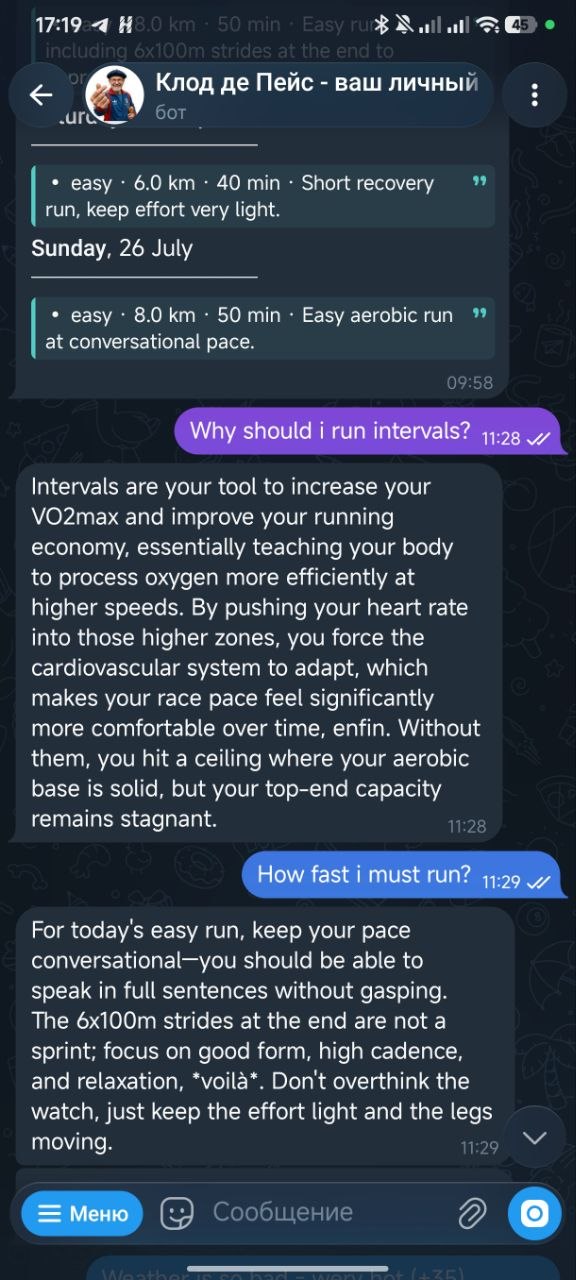
Why intervals?
Claude explains the purpose — and the right effort.
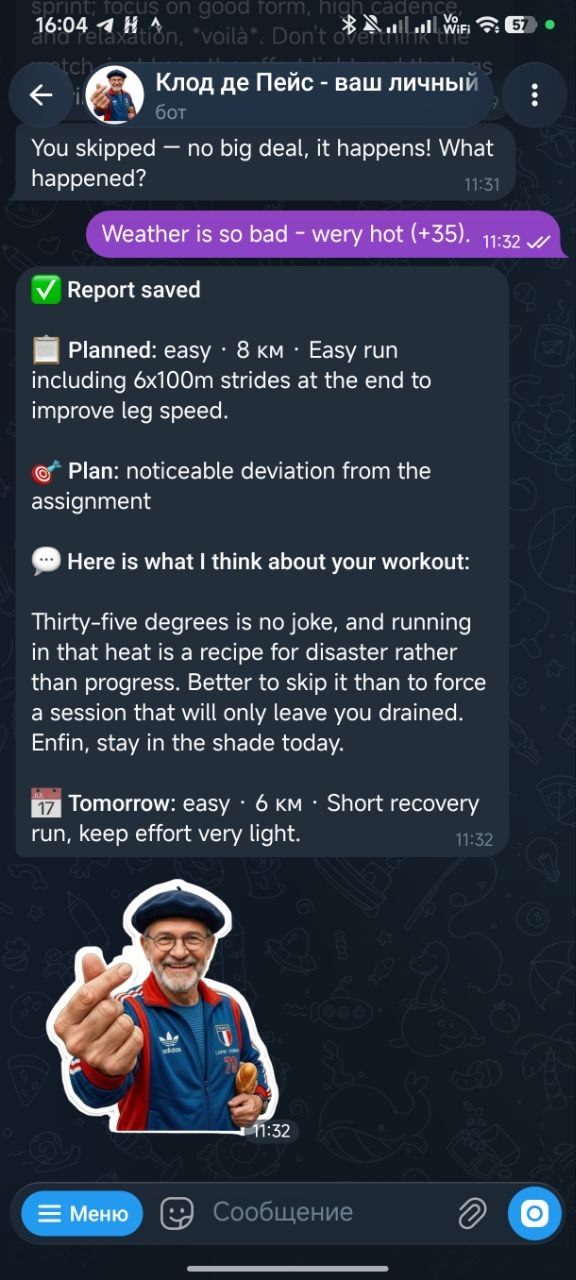
Missed a run? No big deal!
A skip is a signal, not a failure.
Report and next step
What happened, the load, and the coach's take. You can later open the report in /today, edit it or cancel it.
He remembers the details
Injuries, habits, how you react to load — Claude stores them in your profile. Not chat magic: /profile → Memory, which you can review and delete.
/profile → Memory
Pour qui?
Starting from scratch — a nine-week walk-run until 30 minutes of continuous running
Training for more than one race — or a custom distance, not only a calendar marathon
You want consistency instead of one heroic run a month
You're ready to spend 1–2 minutes on a post-run report
You value a real conversation more than another fitness app
Claude doesn't replace a doctor and doesn't diagnose. If you're in pain or injured, see a specialist.
Petites questions
Everything you need to know before your first run with Claude.
No. Claude helps with consistency and load planning. If you're in pain, injured, or unsure — see a specialist.
No — everything works right in Telegram: your plan, reminders, reports, and questions for your coach.
Subscription is 490 ₽ per month or 4,900 ₽ per year. That covers your personal plan, reports, load adjustments, and coaching support in Telegram.
Russian and English. Language and reminder times are in /settings.
No. Distance, time and a load score are enough to begin. Once you have tempo and interval sessions with reports, Claude estimates heart-rate and pace zones, threshold and a race prediction. It is a training-based estimate, not a lab test.
From your reports over the last 4 weeks: distance, time, heart rate, how the load felt. It uses Daniels' VDOT model: HR and pace zones, a threshold and VO₂max estimate, and predictions for 5K / 10K / half / marathon and your goal. You will find it in the profile, under Form. If there isn't enough data, zones are not invented.
Yes. /today shows plan vs fact for the day: you can edit or cancel the report.
Yes: nine weeks of walk-run until 30 continuous minutes, then a regular plan based on your reports.
Yes. Write something like “move the tempo to Saturday”. Claude shows a preview and asks you to confirm. If two hard days would land back-to-back, you get a warning.
À vos marques.
Open the bot, complete a short onboarding, and get your first week of training — 490 ₽/mo or 4,900 ₽/year.
Start on Telegram